Who Is Tracer Bullet? Calvin’s Gritty, Noir Alter Ego
Calvin’s trench-coated character brought razor-sharp wit to the funny pages.

Calvin, from “Calvin and Hobbes,” has numerous alter egos, most famously Spaceman Spiff, the alien-battling galaxy explorer, and Stupendous Man, the masked superhero. Perhaps lesser known, but equally beloved by fans, is Tracer Bullet, the cigarette-smoking, bourbon-slugging, card-dealing private eye.
Tracer Bullet’s panels look and feel markedly different from the typical “Calvin and Hobbes” strip—they’re dark, moody, and smoky. Because of the labor-intensive way they were drawn and inked, creator Bill Watterson only introduced Tracer three times in the decade-long run. “Tracer Bullet stories are extremely time-consuming to write, so I don’t attempt them often,” Watterson explained in The Calvin and Hobbes Tenth Anniversary Book.
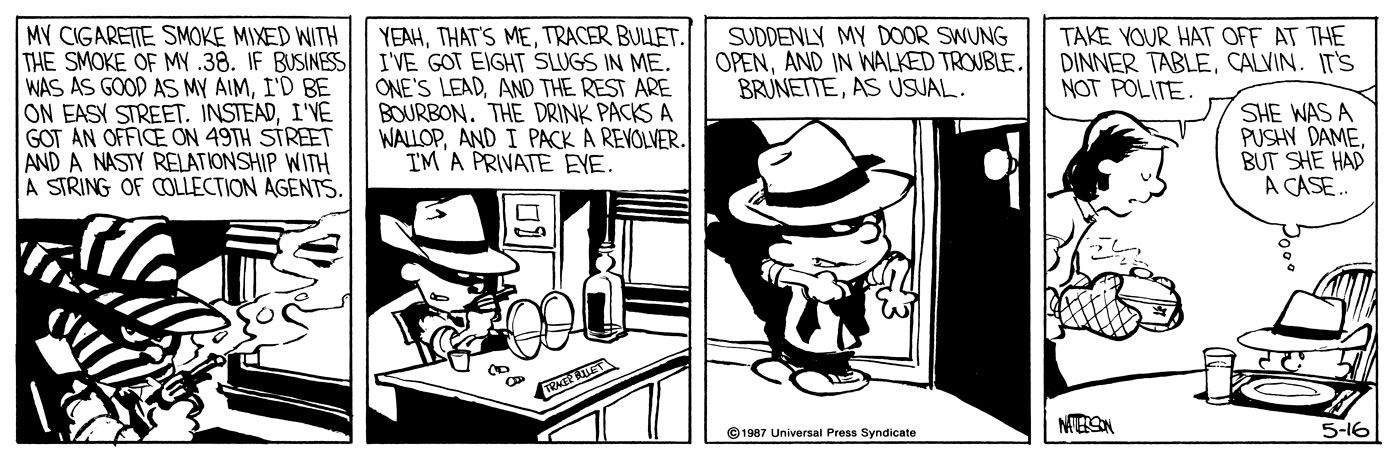
We’re first introduced on May 16, 1987 after Calvin receives a less-than-favorable haircut from Hobbes. Their solution? A fedora-style hat with a tipped up brim, from which Tracer Bullet is born. The entire arc drew a few chuckles from Watterson himself.
“I rarely laugh when I’m drawing, but I did when I drew the results of Calvin’s haircut,” Watterson wrote in the Tenth Anniversary Book. “I like the contrast of Calvin and Hobbes’s reactions, and as a bonus, this story introduced Tracer Bullet.”
Tracer is conjured when there’s a crime or conundrum to solve (typically caused, not surprisingly, by either Calvin or Hobbes). In the second arc, for example, Calvin takes a math test with a tricky word problem and needs Tracer to investigate the answer. “It was another baffling case. But then, you don’t hire a private eye for the easy ones …” Ultimately Tracer does Calvin dirty, settling on “Mr. Billion” for the answer. (It was 15.)
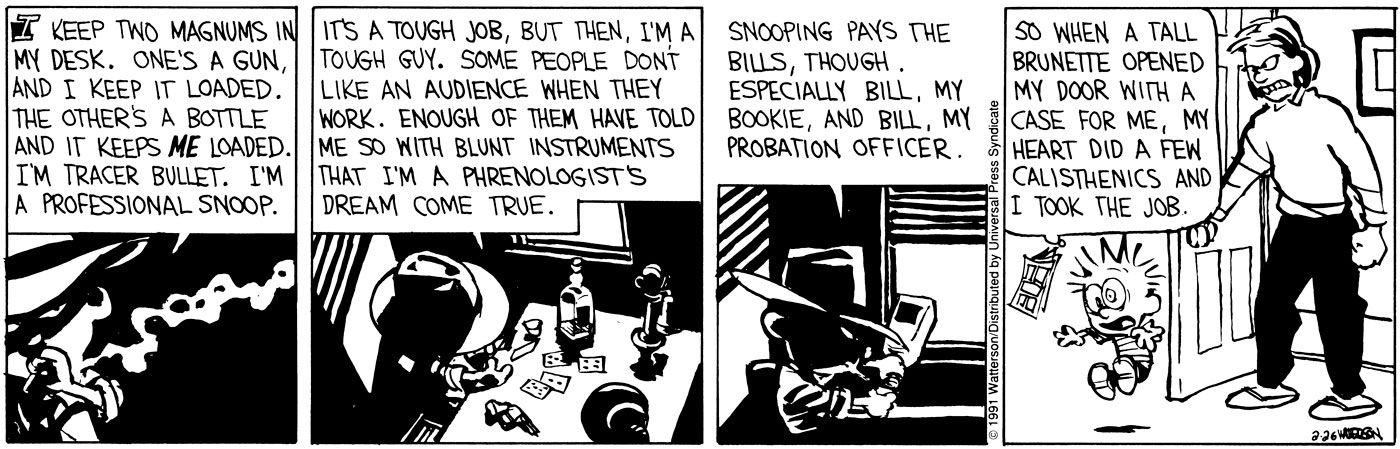
For his third and final case, Tracer is hired to snoop out who shattered Calvin’s mom’s lamp. (This arc, by the way, includes one of the strip’s funniest one-liners: “Snooping pays the bills, though. Especially Bill, my bookie, and Bill, my probation officer.”) In Calvin’s fantasy, Tracer takes the case from a pushy brunette dame—his mom—who ultimately sets him up. A dart gun enters the chaos, followed by the dame’s so-called hired goon, Calvin’s dad. The case closes when Tracer refuses to reveal the real culprit: Hobbes and a football.
Watterson admitted he wasn’t “at all familiar with film noir or detective novels,” calling Tracer’s adventures little more than spoofs of the genre. But for readers, these brief, shadowy interludes did more than parody—they revealed just how far Calvin’s imagination could stretch. Tracer Bullet may have only appeared three times, but like any good detective, he left us with cases that linger long after the final panel.